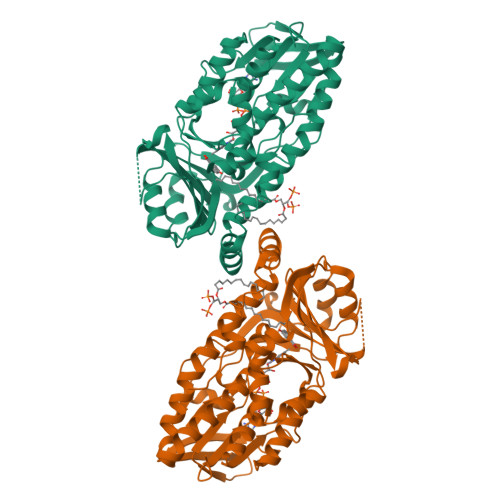
In enzymology, a 4-hydroxybenzoate 1-hydroxylase (EC 1.14.13.64) is an enzyme that catalyzes the chemical reaction
- 4-hydroxybenzoate NAD(P)H 2 H O2 hydroquinone NAD(P) H2O CO2
The 5 substrates of this enzyme are 4-hydroxybenzoate, NADH, NADPH, H , and O2, whereas its 5 products are hydroquinone, NAD , NADP , H2O, and CO2.
This enzyme belongs to the family of oxidoreductases, specifically those acting on paired donors, with O2 as oxidant and incorporation or reduction of oxygen. The oxygen incorporated need not be derived from O2 with NADH or NADPH as one donor, and incorporation of one atom o oxygen into the other donor. The systematic name of this enzyme class is 4-hydroxybenzoate,NAD(P)H:oxygen oxidoreductase (1-hydroxylating, decarboxylating). This enzyme is also called 4-hydroxybenzoate 1-monooxygenase. This enzyme participates in 2,4-dichlorobenzoate degradation. It employs one cofactor, FAD.
References
- van Berkel WJ, Eppink MH, Middelhoven WJ, Vervoort J, Rietjens IM (1994). "Catabolism of 4-hydroxybenzoate in Candida parapsilosis proceeds through initial oxidative decarboxylation by a FAD-dependent 4-hydroxybenzoate 1-hydroxylase". FEMS Microbiol. Lett. 121 (2): 207–15. doi:10.1111/j.1574-6968.1994.tb07100.x. PMID 7926672.